Roof claims and the matching problem: when a few damaged shingles mean a new roof, and when they don't
Hail hits a neighborhood. The adjuster walks your roof, marks six squares of damaged shingles on the south slope, and writes an estimate to repair those six squares. The roofer says that won't work: the shingle line was discontinued years ago, the new shingles will be a different color, and the patch will be visible from the street for the rest of the roof's life. One of them is talking about $3,400 and the other about $16,800.
This is the matching problem, and it shows up on more roof and siding claims than any other dispute. This guide covers how insurers and state rules handle it, the tests that decide whether a partial repair is even possible, how roof age and payment schedules change the numbers, and what to gather before you push back on a scope.

Why the scope matters more than the price per square
Roofers price work by the square (100 square feet). On our example roof, every scope uses roughly the same price per square. The difference is how many squares get replaced.
| Scope | Squares | Estimate | Insurer pays after $2,500 deductible |
|---|---|---|---|
| Repair only the damaged shingles | 6 | $3,400 | $900 |
| Replace the entire south slope | 10 | $5,600 | $3,100 |
| Replace the entire roof | 30 | $16,800 | $14,300 |
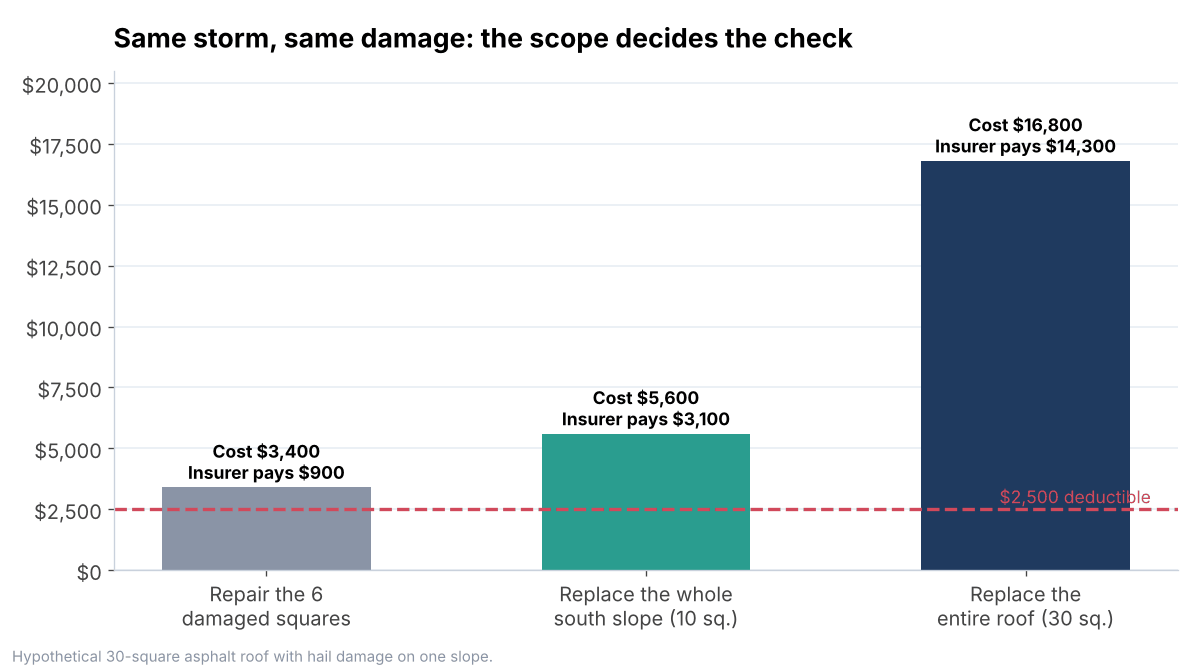
The spot-repair figure includes a minimum charge, because no roofer will mobilize a crew for a couple of hours of work at a pure per-square rate. That's normal, and it's one reason small repair estimates often look odd.
What the policy actually promises
A typical homeowners policy promises to pay to repair or replace damaged property with material of like kind and quality. It does not usually say anything about matching. That silence is where the dispute comes from: the insurer reads it as an obligation to fix the damaged shingles, and the homeowner reads like kind and quality as a roof that looks like one roof.
Three other things fill the gap:
- State regulations. Many states have adopted some version of a model claims-handling rule that, when replacement items don't reasonably match in quality, color, or size, requires the insurer to replace items in the area so the result has a reasonably uniform appearance. The wording, and how far "the area" extends, varies by state. Some states have no rule at all.
- Matching limitation endorsements. Some policies, especially in hail-prone states, now include an endorsement saying the insurer will pay only for the damaged area and won't pay to replace undamaged material to achieve a match. If your policy has one, it usually controls over the general practice.
- Cosmetic damage exclusions. Common on metal roofs. Dents that don't let water in aren't covered at all, so matching never comes up.
The tests that decide whether repair is possible
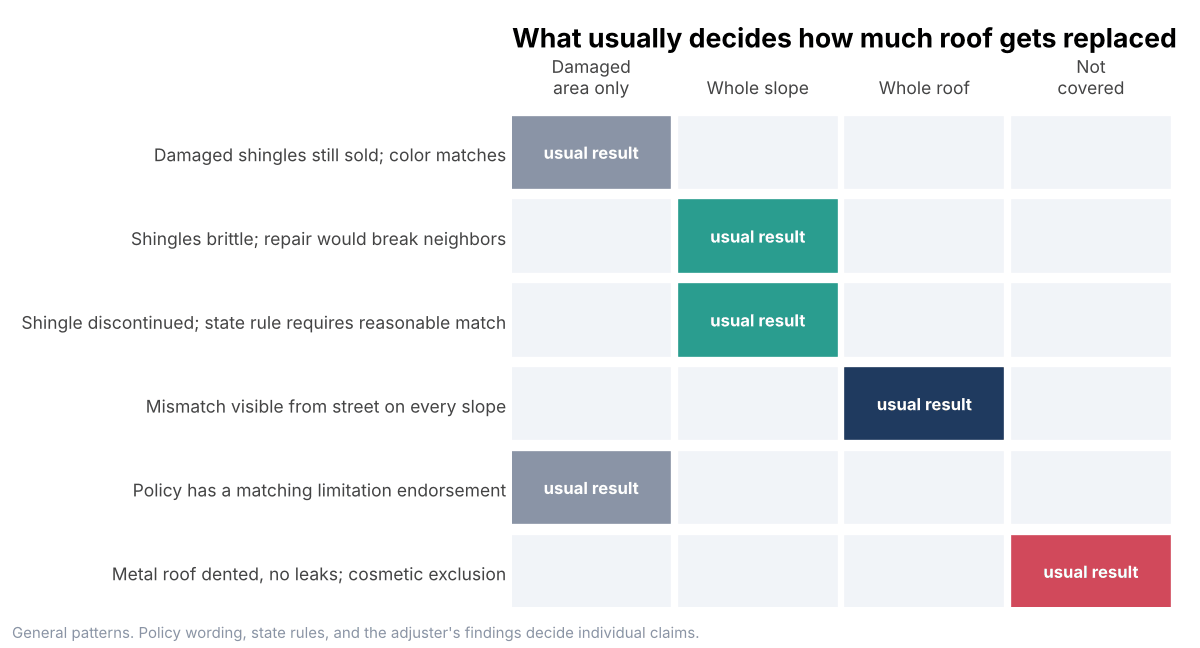
Before anyone argues about appearance, the adjuster and the roofer should agree on whether the damaged shingles can be repaired at all. These are the usual checks:
- Availability. Is the same shingle, in the same color and size, still manufactured? A shingle identification report from a lab can match a sample to current products. If the exact product is discontinued, that's strong evidence for a larger scope.
- Size compatibility. Older shingles often have a different exposure (the visible height of each course) than current metric-size shingles. A different exposure means the new courses won't line up with the old ones.
- Brittleness. Asphalt shingles get brittle with age. A common field test lifts the tabs of undamaged shingles near the damage. If they crack or tear, removing damaged shingles will break the good ones around them, and a clean repair isn't possible.
- Sealant. Shingles bond to the course below. If they can't be unsealed and resealed without damage, partial repair creates new weak points.
- Appearance. Even with the "same" product, new granules are brighter than weathered ones. Whether that difference is acceptable is a judgment call, which is why state matching rules use the words reasonably uniform.
Slope vs. whole roof
Where matching applies, the debate usually moves from "damaged shingles only" to "how far does the match extend?" Many adjusters treat each roof slope as its own area. A new south slope next to an old west slope is arguably acceptable because you can't see both at once from most angles. Others look at line of sight: if two slopes are visible together from the street, they are one area. If the mismatch is visible across every slope, the case for a full replacement gets stronger. Photographs from the street, the driveway, and the neighbor's yard are useful evidence here.
Roof age and payment schedules
A growing number of policies don't pay replacement cost on older roofs. Some pay actual cash value (replacement cost minus depreciation). Others use a roof payment schedule that pays a fixed percentage of the roof cost based on age and material.
Using a hypothetical schedule that pays 100% on a new roof, drops 4 percentage points a year, and bottoms out at 30%, here is what a $16,800 full replacement pays after a $2,500 deductible:
| Roof age | Schedule pays | Amount before deductible | Payment |
|---|---|---|---|
| 5 years | 80% | $13,440 | $10,940 |
| 10 years | 60% | $10,080 | $7,580 |
| 15 years | 40% | $6,720 | $4,220 |
| 20+ years | 30% | $5,040 | $2,540 |
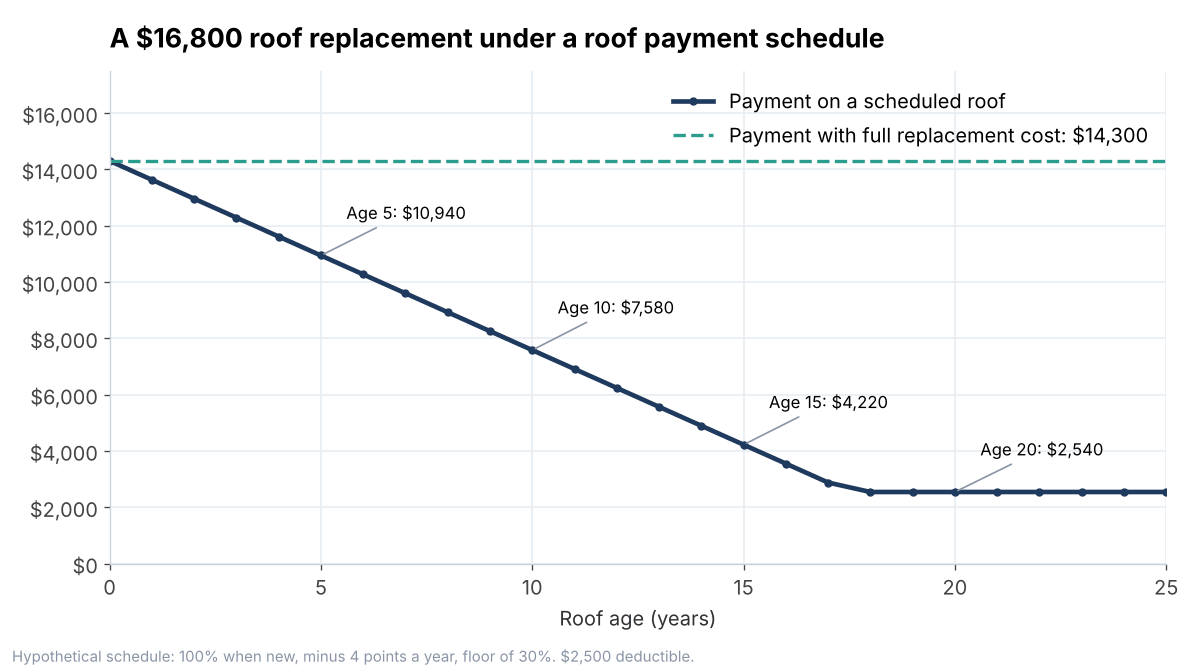
This changes the strategy. On a young roof with replacement-cost coverage, the scope argument is worth a lot of money. On a 20-year-old roof under a schedule, the gap between a slope and a full roof might be only a few thousand dollars after the deductible. It can still be worth pursuing, but it's worth knowing the real stakes first.
Siding, gutters, and the rest of the exterior
The same logic applies to siding, and siding mismatches are often worse than roofing ones, because siding is at eye level. Vinyl siding fades, profiles get discontinued, and a single replaced wall in a new color is hard to miss. Gutters and downspouts are usually treated run by run. Window screens and wraps are usually replaced per window.
When a storm damages several parts of the exterior, each one gets its own scope decision, but they all come out of one deductible.
How to handle a scope you think is too small
- Read your policy for a matching endorsement or cosmetic exclusion before arguing. If the policy limits matching, a state rule usually won't help.
- Ask the roofer for a written repairability assessment. It should cover product availability, exposure size, a brittleness test with photos, and sealant condition.
- Get a shingle identification report if the product's availability is in question.
- Photograph sightlines. Show which slopes are visible together from the street and neighboring properties.
- Ask the adjuster to reinspect with your roofer present. Many scope disputes get resolved on a second visit, when both sides look at the same evidence together.
- Find your state's claims-handling rules. Your state insurance department's website will show whether it has a matching provision.
- Know your escalation options. If you still disagree, your policy's appraisal clause, a complaint to the state insurance department, or a licensed public adjuster are the usual next steps.
Frequently asked questions
Does my insurer have to replace my whole roof if they can't match the shingles? Not automatically. It depends on your state's rules and your policy wording. In states with a matching rule, the requirement is usually a reasonably uniform appearance within the affected area, not necessarily the whole roof.
Can I pay the difference to replace the whole roof myself? Yes. Many homeowners use the claim payment toward a full replacement and pay the rest. Tell your insurer, because replacement-cost holdbacks are usually paid against the actual work completed.
My roof was damaged, but the adjuster says it's "wear and tear." Is that a matching issue? No. That's a causation dispute about whether the storm caused the damage. Settle causation first, then scope.
Will a new section of shingles blend in over time? Somewhat. Granule color settles over the first year or two, but differences in product, profile, and exposure don't fade.
Sources and further reading
- National Association of Insurance Commissioners: Unfair Property/Casualty Claims Settlement Practices Model Regulation
- Insurance Information Institute: Settling insurance claims after a disaster
- Federal Alliance for Safe Homes: Roofing and hail resources
Hypothetical figures. General information only, not insurance advice. Matching rules vary by state and policy; your policy wording and state regulations control.