Wind and hail percentage deductibles: what 2% really costs on a $400,000 house
Most homeowners know their deductible as a single number: $1,000, maybe $2,500. Then a hailstorm comes through, the roofer says the whole roof needs replacing, and the claim letter shows a deductible of $8,000. Nobody changed the policy. The number was there the whole time, written as a percentage on the declarations page.
Wind and hail deductibles, along with named storm and hurricane deductibles, are calculated from the dwelling limit, not from the size of the damage. In storm-prone states they are now the norm rather than the exception. This guide shows how the math works, what it means on real claims, how to decide whether a higher percentage is worth the discount, and the details in the policy wording that change the answer.

How a percentage deductible is calculated
The formula is simple:
Deductible = percentage × Coverage A (dwelling limit)
Coverage A is the amount the policy would pay to rebuild the house itself. It is not the market value of the home and it is not the size of the claim. On a house insured for $400,000, a 2% wind and hail deductible is $8,000 whether the storm causes $9,000 of damage or $90,000.
| Dwelling limit | 1% | 2% | 5% |
|---|---|---|---|
| $250,000 | $2,500 | $5,000 | $12,500 |
| $400,000 | $4,000 | $8,000 | $20,000 |
| $600,000 | $6,000 | $12,000 | $30,000 |
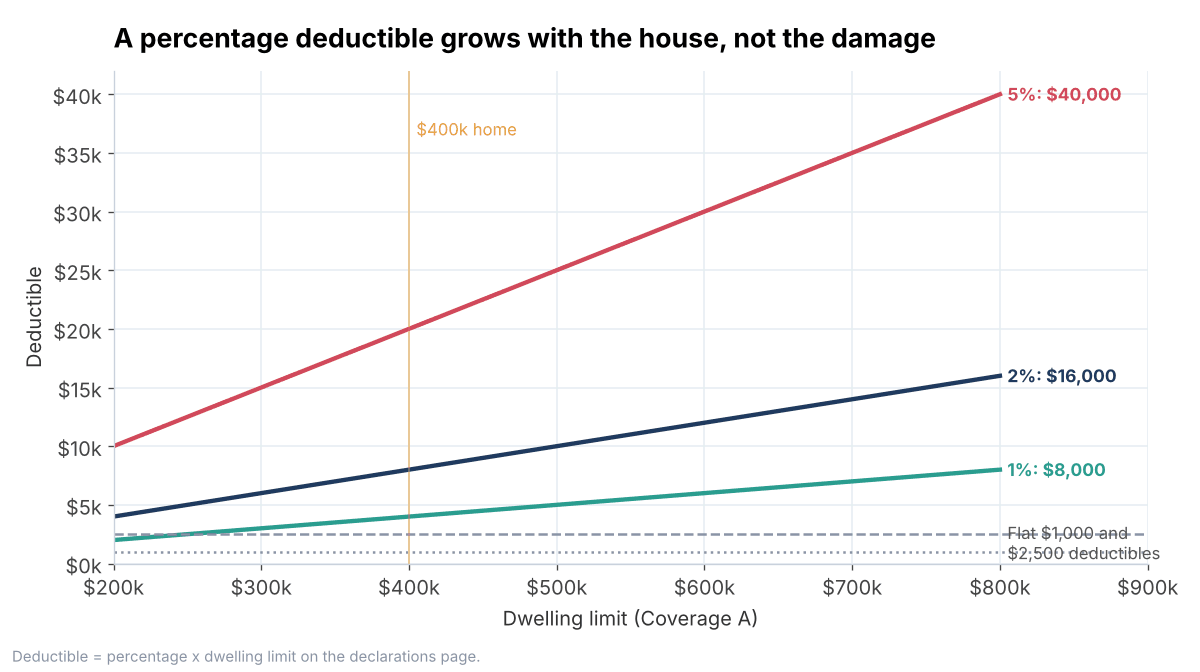
Most policies that use a percentage deductible for wind still use a flat deductible, often called the all other perils (AOP) deductible, for everything else: fire, theft, a burst pipe. The same house can carry a $2,500 deductible for a kitchen fire and an $8,000 deductible for a hail claim.
Which deductible applies to which storm
The labels vary by insurer and state, but you will usually see one of these on the declarations page:
| Deductible type | Usually applies when | Typical range |
|---|---|---|
| Wind and hail | Damage is caused by wind or hail from any storm | 1% to 5% |
| Named storm | A storm named by the national weather authorities causes the damage | 1% to 5% |
| Hurricane | A hurricane watch or warning has been issued for the area, within a defined window | 1% to 10% |
| All other perils (flat) | Everything else, and sometimes wind if no separate deductible is listed | $500 to $5,000 |
Hurricane deductibles usually have a trigger written into the policy: for example, from the time a hurricane watch or warning is issued until a set number of hours after it ends. Damage outside that window falls back to the wind and hail deductible or the flat deductible. Some states apply the hurricane deductible once per calendar year. Florida does this, so if a homeowner meets the hurricane deductible in August, a second hurricane in October uses whatever remains of that deductible or the regular deductible, whichever is greater, instead of a fresh 2% or 5%.
Three hail claims on the same house
Take a house insured for $400,000. The owner has a $2,500 AOP deductible and the option of a 2% or 5% wind and hail deductible. Here is what each choice means on three realistic storm claims.
| Covered damage | Flat $2,500: you pay | 2% ($8,000): you pay | 5% ($20,000): you pay |
|---|---|---|---|
| Gutters, screens, a few shingles: $6,500 | $2,500 | $6,500 (no payment) | $6,500 (no payment) |
| Full roof replacement: $14,000 | $2,500 | $8,000 | $14,000 (no payment) |
| Roof, siding, gutters, two windows: $38,000 | $2,500 | $8,000 | $20,000 |
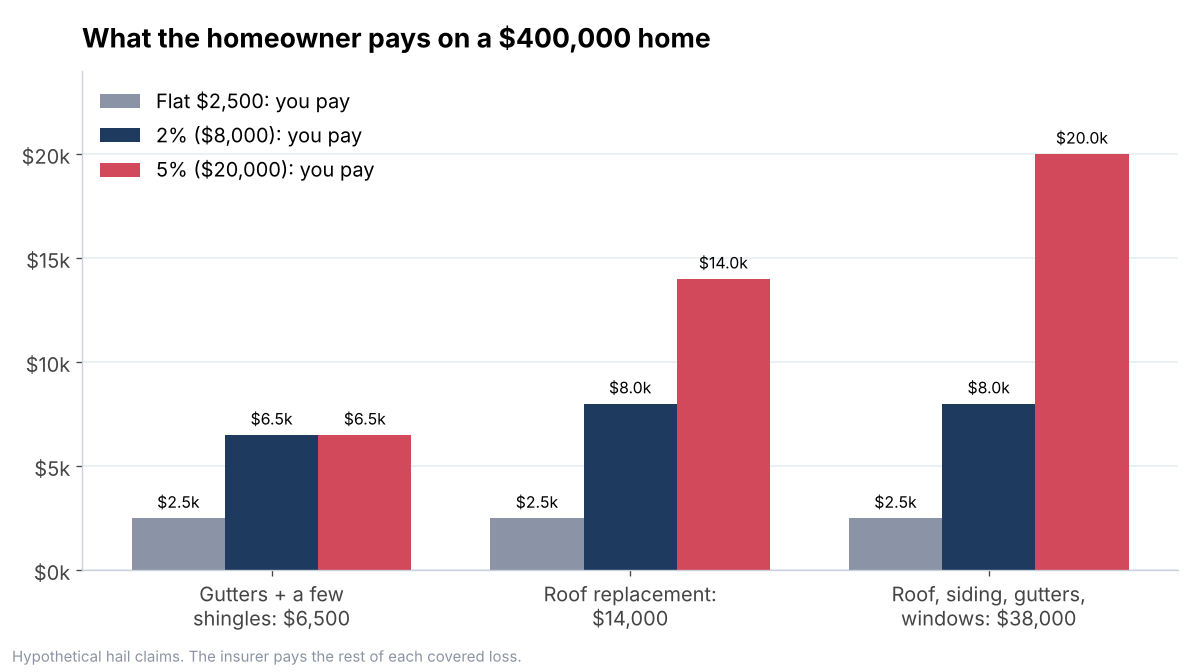
Two things stand out. First, with a 5% deductible, a full roof replacement can be entirely out of pocket. That is a common surprise. Second, small claims just above the deductible pay very little. A $8,500 hail claim on a 2% policy pays $500, and it still goes on the property's claim history, which future insurers can see. Many owners decide not to file at that point. That decision is easier to make calmly if you know the dollar figure before the storm.
Is the higher percentage worth the discount?
Insurers price the higher percentage lower, sometimes substantially in hail country. The question is whether the premium you save covers the extra amount you would pay when a storm hits.
Suppose moving from 1% ($4,000) to 2% ($8,000) on the $400,000 house saves $420 a year. The extra exposure per qualifying claim is $4,000. A qualifying claim is any wind or hail loss above $8,000, because below $4,000 neither deductible pays and between the two the difference is smaller.
- If a claim that size happens on average once every 8 years, the expected extra cost is $4,000 ÷ 8 = $500 a year, more than the $420 saved.
- If it happens once every 15 years, the expected extra cost is about $267 a year, less than the $420 saved.
- The break-even point is $4,000 ÷ $420 ≈ 9.5 years between qualifying claims.
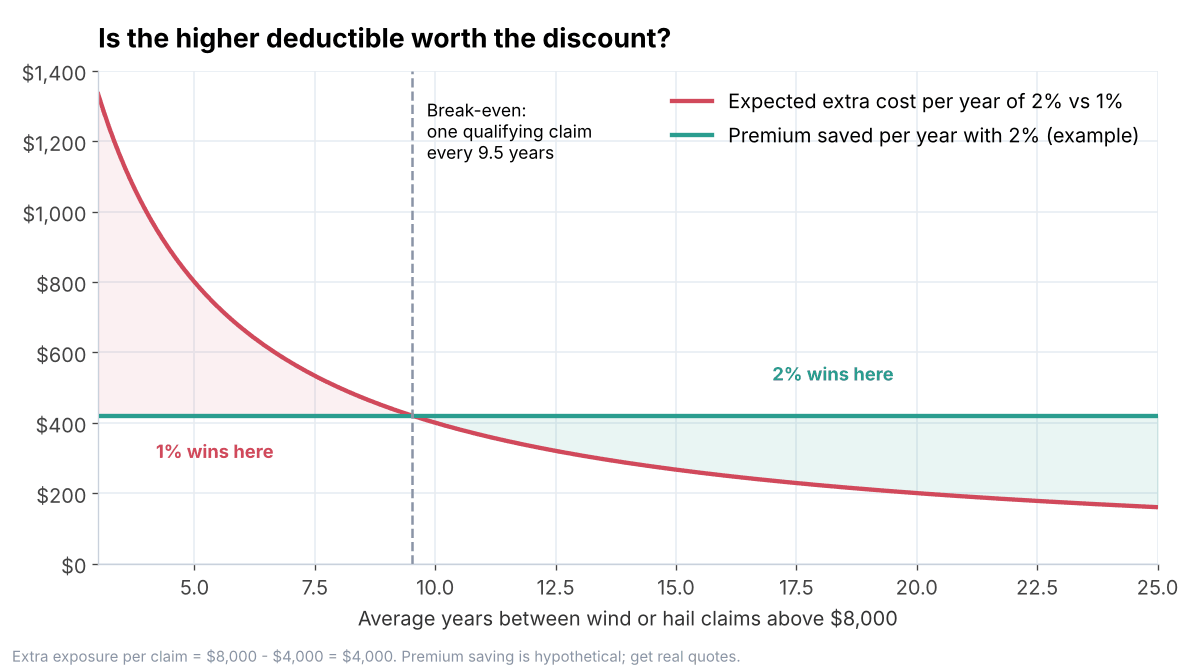
Expected value isn't the whole story. A $4,000 swing hurts more if it comes in a year when you are also paying for temporary repairs, a rental car after hail damage, or time off work. If an $8,000 bill would go on a credit card, the lower deductible is worth more to you than the arithmetic suggests. If you have the cash and you live somewhere hail is rare, the higher deductible usually comes out ahead over time.
For a broader look at how wind and hurricane deductibles differ by state and how to read the trigger language, see this explainer on wind and hurricane deductibles.
The deductible rises every year, even if you never touch the policy
Many homeowners policies include an inflation guard that raises the dwelling limit automatically at each renewal, often 4% to 8% a year, to keep pace with construction costs. That protects you from being underinsured. It also raises every percentage deductible on the policy.
| Year | Dwelling limit (5% annual increase) | 2% deductible |
|---|---|---|
| 0 | $400,000 | $8,000 |
| 1 | $420,000 | $8,400 |
| 2 | $441,000 | $8,820 |
| 3 | $463,050 | $9,261 |
| 4 | $486,203 | $9,724 |
| 5 | $510,513 | $10,210 |
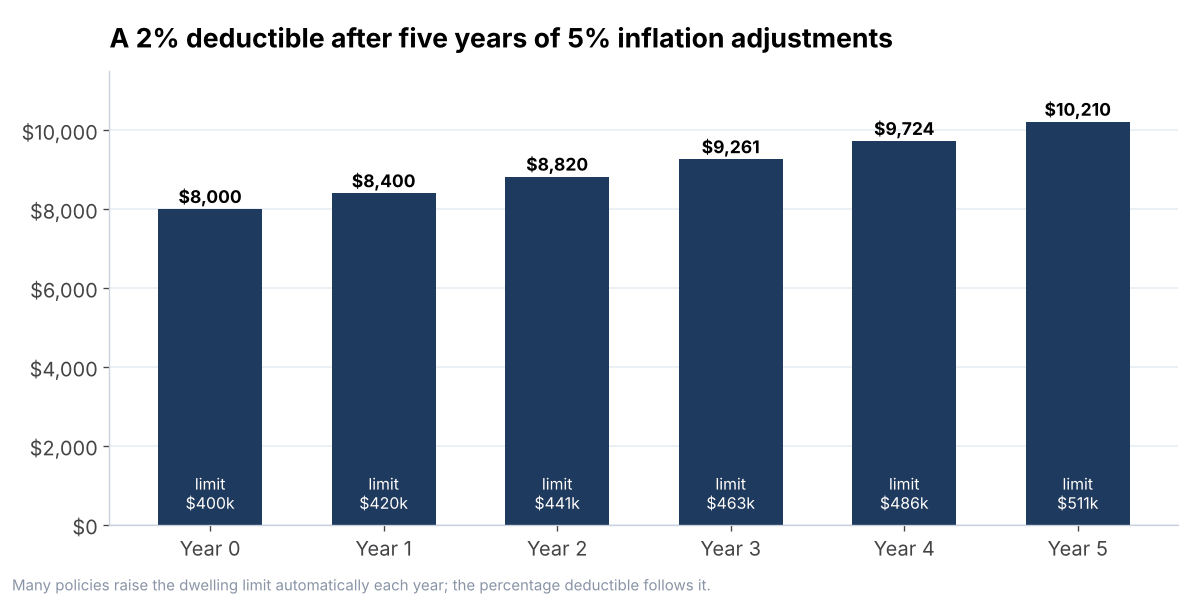
Don't respond by cutting the dwelling limit to shrink the deductible. Being underinsured on the house is a far bigger risk than a few thousand dollars of deductible. If the dollar figure gets uncomfortable, ask for a lower percentage, or ask whether a fixed-dollar wind deductible is available.
Details in the wording that change the outcome
What counts as wind damage. If wind tears off shingles and rain then soaks the attic and ceilings, many policies apply the wind deductible to the whole loss, interior water damage included, because the wind caused the opening. A ceiling leak after a storm can therefore fall under the larger deductible even though no one would call it wind damage.
Per occurrence vs. per season. Most wind and hail deductibles apply per occurrence. Two separate hailstorms in May and July mean two deductibles. When storms come close together, the policy's definition of an occurrence (often a period such as 72 hours) decides whether you pay once or twice.
Other structures and contents. The deductible is calculated from Coverage A but usually applies to the whole claim, including fences, sheds, and belongings damaged in the same storm. You don't get a separate deductible for each.
Roof payment schedules. Some policies pay roofs on a depreciated or scheduled basis once they pass a certain age. Combined with a percentage deductible, an older roof can produce a payment of zero even after a severe storm. If your roof is more than 10 to 15 years old, read the roof section of the policy and the deductible section together.
Cosmetic damage exclusions. Hail can dent metal roofing, vents, and gutters without causing leaks. Some policies exclude damage that affects only appearance. Combined with a large deductible, this can mean visible hail damage that the policy never pays for.

What you can do before the next storm
- Find the dollar figure. Multiply each percentage on your declarations page by your current dwelling limit. Write the numbers down where you'll see them.
- Hold cash for it. A wind deductible is a predictable expense in storm country. Keep a separate savings bucket sized to at least the 1% or 2% figure.
- Ask for quotes at two or three percentages. Run the break-even math above with real numbers instead of guessing.
- Ask about mitigation credits. Impact-resistant roofing, roof-to-wall connections, and opening protection can earn premium discounts in many states. Sometimes the discount is enough to keep a lower deductible affordable.
- Photograph the exterior now. Date-stamped photos of the roof, gutters, and siding make it easier to show which damage is new after a storm.
- Check the trigger language. If you live in a hurricane state, know exactly what starts and ends the hurricane deductible window.
Frequently asked questions
Can I choose a flat-dollar wind deductible instead? Sometimes. In some areas insurers offer it for a higher premium. In the highest-risk coastal areas, a minimum percentage is often required.
Does the wind deductible apply if a tree falls on my house during a storm? Usually yes, if wind caused the tree to fall. Tree removal coverage often has its own small limit. Debris removal may fall under the same deductible.
If two neighbors file for the same storm, do they have the same deductible? Only if their dwelling limits and percentages match. A larger house with the same 2% deductible carries a larger dollar amount.
Will filing a small claim just over my deductible raise my premium? It can. A claim adds to your loss history even when the payment is small. Weigh the payment against the possible effect on renewals before filing.
Sources and further reading
- Insurance Information Institute: Background on hurricane and windstorm deductibles
- National Association of Insurance Commissioners: Consumer insurance resources
- Florida Office of Insurance Regulation: Hurricane deductible information
Hypothetical figures. General information only, not insurance advice. Deductible rules vary by insurer and state; your policy wording controls.